
While there are many reasons why starting a business is an exciting prospect, there’s one thing that needs to be considered financially: what happens if things don’t go well? The type of structure you choose may have an impact on your tax obligations, paperwork, management, and the ability to protect assets in case your business gets in debt.
A lot of individuals would-be entrepreneurs in search of a limited liability corporation are actually interested in a limited liability company, which is often referred to as an LLC. The legal term used in the U.S. is “limited liability company”. An LLC is established according to state laws and provides liability protection with significant flexibility in managing and taxation of the business.
This mix of factors has led to the fact that an LLC business has become a valuable choice to anybody, from an individual entrepreneur and consultant to the family business and multiple owners. But the creation of one does not add up to an answer to all issues of law or tax. By learning what an LLC offers, how LLCs are taxed, and what roles you’ll have to fill after creation, you can determine whether or not this entity is right for your business.
What Is a Limited Liability Corporation and How Does It Work?
The term “limited liability corporation” is commonly used, but LLC is actually short for limited liability company.
It is important because an LLC and a corporation are different types of businesses. LLCs are formed according to state laws, and their owners are referred to as members. Single-member LLCs are generally allowed to exist in most states, and multiple-member LLCs are allowed; the owners may be individuals or other business entities.
The concept is simple: The business has a separate legal entity from the owner(s) for the purposes of liability.
Let’s say you began a home remodeling business. A customer has a valid claim against the company, valued at $40,000. However, if the business entity was properly organized and maintained as an LLC, the claim will typically hit business assets, and not automatically be your personal $40,000 claim.
This separation can help protect assets, which include:
- Personal savings
- A personal checking account is a must.
- A car that belongs to another person.
- Personal investments
Other assets which do not belong to the business, but are owned by the member.
But “limited liability” does not equal “no liability.”
Even with cases of personal wrongdoing of an owner, personal guarantees, or where a court decides that it ought to disregard the separation between the owner and company, an owner may still be held personally responsible. One of the reasons why good recordkeeping and separation of personal and business finances are important.
LLCs provide flexibility in management, as well. Organizations can typically be member-managed LLCs, where the members are the owners and hold trading authority, or manager-managed LLCs, which have appointed managers that have the business trading authority.
Why Business Owners Choose an LLC
There is so much attention paid to liability protection, but it’s not the only aspect. The LLC can be helpful for those who wish to formalize a business entity but do not need all the usual corporate governance aspects.
Some of the greatest potential benefits are:
- Personal asset protection: Business liabilities typically stay with the business and do not pass automatically to the members of the company.
- Favorable ownership structure: LLCs can have one member or more, and the number of restrictions on members varies widely by state.
- Management flexibility: one can handle the business personally or hire managers.
- Federal tax: Federal taxes may be either of the members or of the LLC, based on the LLC’s number of members and choices made with the IRS.
- Simpler corporate structure: LLCs don’t require the same sort of shareholder and board structure as the traditional corporation.
- Professional identity: LLC structure provides a better barrier between the individual and the entity that they operate.
There are drawbacks, too.
Formation and ongoing requirements vary from state to state. If you are based in one of these locations, you may have to pay initial filing fees, annual and periodic reports, state taxes, franchise taxes, registered-agent fees, or other compliance forms.
An LLC also may not be the best choice for a business that is planning a considerable amount of outside funding by traditional share sales. Corporations can sell shares of stock, and the ownership of an LLC is based on membership interests.
The superior structure, as a result, relies on what you’re building. A freelancer looking for liability separation might have a different agenda than, say, a startup looking for a string of institutional investments.
How to Form an LLC in the United States
Since LLCs are formed under state law, there is no one nationwide process for creating an LLC. Because of this, requirements, fees, forms, and other requirements to file can vary from state to state.
Still, the formation process commonly involves the following steps:
1. Choose the state where you will form the business
In many small businesses, this is the only condition that a lot of businesses operate under. If you continue to conduct business in your home state, you may be subject to extra registration/compliance requirements if they are formed in another state.
2. Select an available business name
Each state has regulations related to LLC names. A name usually needs to be identifiable, has to meet state naming regulations, and is required to have some sort of identifier like LLC.
However, a state-level name search isn’t equivalent to a federal trademark search, so businesses intending to create a well-known brand should think about both.
3. Appoint a registered agent
In most cases, an LLC requires a registered agent who is able to act as a legal receiving point to receive service of process and correspondence from the government. Each state has its own requirements.
4. File the formation document
This document is often referred to as the Articles of Organization; some states refer to it by a different name. It is submitted in the usual manner of filing with the State agency at the usual filing fee.
5. Create an operating agreement
An operating agreement sets guidelines for the operation of the LLC. It can include provisions for: proportions of ownership, voting rights, management authority, profit distribution, termination of membership, dispute resolution, and even company liquidation.
Even if there is no such requirement under state law, a properly drafted agreement can be of significant value for particular multi-member businesses.
6. Handle tax and regulatory requirements
Other actions that may be necessary may involve registering for required state taxes, applying for licenses and permits, and getting an Employer Identification Number, depending on the business.
Formation is just the first step. Also be mindful of the state’s ever-changing requirements relating to reporting, fees, taxes, licensing, and recordkeeping.
How LLC Taxes Work
One of the biggest areas of confusion for LLC owners is taxes since LLCs are organized under state law and their federal tax classification varies based on the number of shareholders and the type of business.
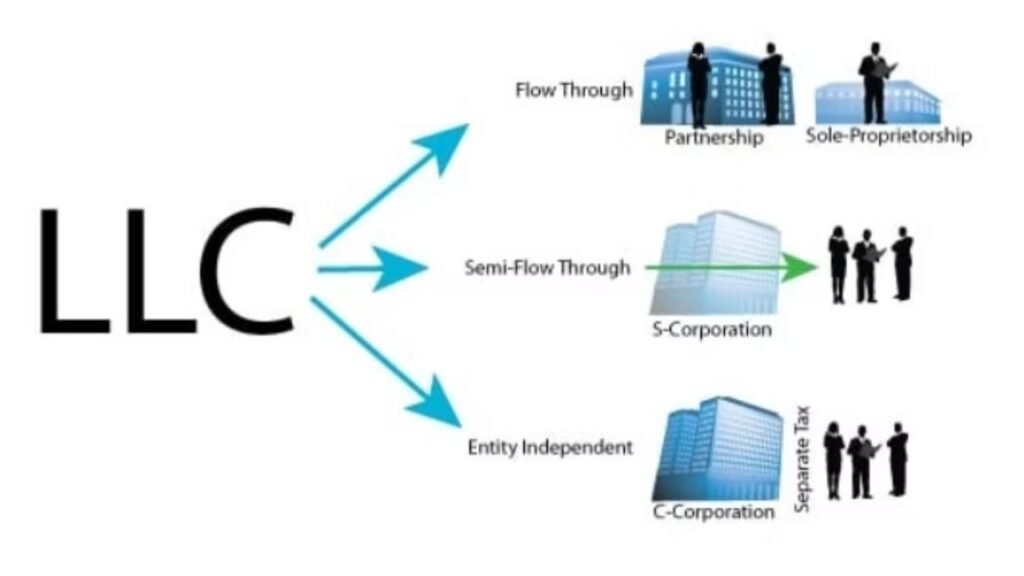
Generally, a domestic single-member LLC does not exist for federal income tax purposes according to the IRS, except in so far as it chooses to be taxed as a corporation. Generally, the owner’s business activity is listed on their federal income tax return.
Unless a domestic LLC elects to be treated as a corporation, a domestic LLC with two or more members is generally treated as a partnership for federal income tax purposes.
- In simplified terms: Single-member LLC: automatically considered a “disregarded entity” for federal income tax purposes.
- Multi-member LLC: By default, taxed as a partnership.
- LLC electing corporate taxation: An LLC may elect to be a corporation, nonprofit, school, hospital, etc. for federal tax purposes.
- Eligible LLC electing S corporation status: If applicable, a qualifying business can elect to become an S corporation.
This flexibility comes at a cost, but it does not necessarily imply that one tax treatment is more cost-effective.
These factors can all depend on your income, payroll, expenses, and number of owners, the state of the operation, as well as your long-term business plans. There can also be very interesting disparities at the state level.
Therefore, selecting an LLC and selecting a classification should be considered a two-part decision.
LLC vs Sole Proprietorship vs Corporation
Choosing a business structure becomes easier when you understand what actually changes between the major options.
Sole proprietorship
One person starting a business may choose to operate as a sole proprietorship, which is likely the easiest form of business. Being a sole proprietor doesn’t necessarily form a separate business entity – and that means there is not as much of a separation from the liability for the business as there is with an LLC.
Though it may be simple, simplicity means a higher number of obstacles for people in the business.
Limited liability company
Establishing an LLC establishes a legal business organization and usually offers limited liability to the members. It provides some very good freedom of ownership, management, and federal tax status as well.
For many small-business owners, those qualities would make it a worthwhile consideration if they wanted to separate business and personal finances.
Corporation
A corporation has the same liability protection; however, its ownership and governance are different. A corporation can have shareholders and issue shares so the structure might be useful for firms looking for certain types of outside funding.
Corporations can also include more formal governance requirements.
None of these structures is an automatic fit for each business. Your liability exposure, ownership plans, tax status, administration requirements, financing plan, and state requirements should all play a role in the decision.
Common LLC Mistakes and How to Avoid Them
Many states have easy LLC formation procedures. Legal aspects to stay compliant take more focus due to separation.
Here are some of the more typical errors to look out for:
- Commingling of personal and/or business funds: Keep business funds separate and keep good books.
- If one says that an LLC is a replacement for insurance, the two are really different as well. Individuals may require general liability, professional liability, commercial auto, workers’ compensation, or other coverage, depending on their activities.
- Failing to ignore an operating agreement: Oral contracts with a business partner can be costly arguments down the road.
- Failure to comply with state deadlines: Annual reports, periodic filings, taxes, licenses, and fees may be mandatory to maintain the good standing of the business.
If all business debts are secured, then signing a personal guarantee can make you personally liable for this specific debt.
A tax structure which is efficient for one company may not be for another if not professionally advised.
Failure to remember registrations in other states: Being out of state can lead to further registration and compliance obligations.
One helpful guideline is to act as though the LLC were a real, distinct business from the outset. Keep organized records, record important decisions, follow state requirements, and do not use company money to replenish your own checking account.
Frequently Asked Questions
Is a limited liability corporation the same as an LLC?
LLC is the official abbreviation for limited liability company, and it’s a term that’s used a lot when speaking about LLCs. But a corporation is another type of legal entity.
Does an LLC completely protect personal assets?
As a general matter, the liability of LLCs is shielded, but again, there are exceptions. There may be personal exposure due to personal guarantees, personal wrongdoing, or lack of separation of law.
Can one person own an LLC?
Yes. The vast majority of states provide for single-member LLCs. Generally, the domestic single-member limited liability company will be considered a disregarded entity for federal income tax purposes unless it chooses to file corporate status.
How much does it cost to start an LLC?
No single National price is available. The costs to incorporate and to maintain your business vary by state, and your business may require annual reports, state taxes, registered-agent fees, or other fees.
Do I need an attorney to create an LLC?
Not necessarily. Filing the state formation paperwork is a task that a lot of owners do on their own. Having lots of owners, unconventional ownership structures, substantial liability risks, or atypical tax issues can generate the need for professional legal or tax advice.
Conclusion
A limited liability corporation is an expression that is used by many who are looking for a limited liability company, a small business structure which is known by this name. The LLC offers US entrepreneurs personal liability protection, flexible management, and various federal tax classifications.
Creating one is no cakewalk of paperwork. Things such as state requirements, taxes, operating agreements, financial separation, insurance, and ongoing compliance should be taken into consideration. Before you form an LLC, weigh the expenses and requirements of an LLC against the needs of your business, and consult a professional tax advisor or attorney if your situation is complicated.
For more information, also read our related article here.