
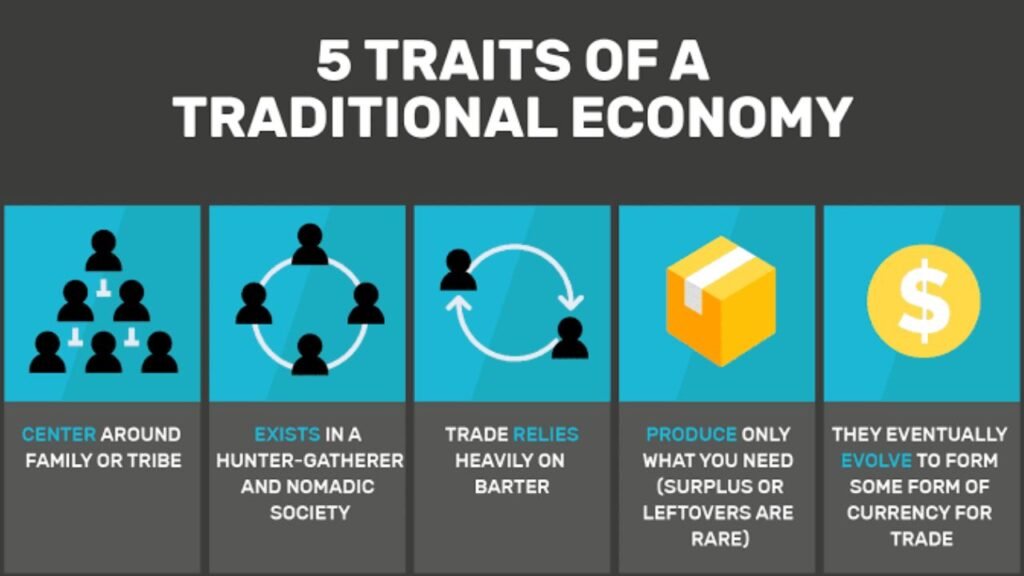
Communities produce goods and distribute resources and meet their daily needs within the context of economic systems. Traditional societies use systems that depend on customs, tradition, and heritage, while other societies, like modern economies, depend on technological advancement, global trade, and financial markets. They give a unique insight into how communities are able to organize economic affairs without relying primarily on modern institutions.
When put in its simplest terms, a traditional economy would be a system in which economic decisions are primarily made on the basis of traditions, beliefs, and practices that have been handed down from generation to generation. This model involves the use of farming, animal husbandry, fishing, hunting, and handmade production methods and does not primarily focus on profit or market competition.
Knowing this type of economy can explain why certain communities still employ methods that have been there for hundreds or even thousands of years. It also contrasts traditional economies with other economic systems like market, command, and mixed economies.
What Is a Traditional Economy?
A traditional economy is a type of economy in which individuals follow traditions, routines, and cultural beliefs to determine their production, production methods, and resource distribution. Decisions within this system tend to be more socially driven than would simply be guided by supply and demand factors.
In these communities, there is a tendency for economic roles to be passed down from generation to generation. A family with 100%, or hundreds of years, of farming land may continue to farm, and other families might concentrate on fishing, crafting, or raising livestock. Parents and elders share skills and knowledge with the younger generation.
Traditional systems typically are more interested in basic needs and the stability of their community than are the various types of market economies where businesses try to maximize their profits. Production will be more rationed to match people’s needs to survive and less to growing on a massive scale.
In many of the more traditional economies, operating in rural or remote locations, access to modern infrastructure, financial services, and global markets might be constrained. But parts of traditional cultural practices may be found in contemporary societies in local farming, artisan activities, and cultural industries.
Key Features of a Traditional Economy
Several characteristics separate traditional economic systems from other types of economies.
Dependence on Customs and Culture
The most significant factor is tradition. Economically, the ideas and customs handed down over years may be relied on. There might be certain regulations and practices within communities regarding the utilization of resources, cultures of production and cultivation.
A farming population, for instance, may persist in growing some crops, even if these are not the best appropriate Chinese agriculture options available, due to good performance maintained for many years. Real knowledge of proper times and seasons for planting, harvesting, and storage of food products generally comes with experience, and not necessarily with education.
Limited Use of Modern Technology
In the traditional economy, simple tools and techniques are used. A significant amount of work to prepare for and maintain them is done by hand, with a lot of activities having been designed over a historical period of time.
This is not to say that these communities are lacking in knowledge and skills. Conventional techniques are knowledge-intensive in many instances. Production levels, however, tend to be lower than those in industrial economies.
Focus on Self-Sufficiency
A Primary Sector economy is the one that has the objective of satisfying the community’s needs instead of generating large profits. Many people “make” a lot of food, clothing, and tools for themselves.
A trade can occur with a barter system in which merchandise or services are traded without the use of money. A farmer may barter merchandise for homemade tools or animal products, for instance.
Strong Community Relationships
Cooperation plays an important role in traditional economic systems. It is common to find work organized into families, tribes, or local groups.
During certain times of the season – farming time, hunting or building – members of a community may have responsibilities. The economy is deeply related to the social links.
Low Economic Growth
Traditional economies are slow to change as production is largely isomorphic and geared towards survivability. Oftentimes, innovation may be slow, as communities like to maintain existing practices.
Examples of Traditional Economies Around the World
Traditional economies can be found in different regions, although many have changed due to globalization and modernization.
Indigenous Communities
Numerous Indigenous communities have traditionally practiced an economic lifestyle that is dependent on hunting, fishing, gathering, and farming. Their economy is frequently related to environmental awareness and culture.
Seasonal cycles are necessary, for instance, to inform some Indigenous societies when to hunt animals, gather plants, or to plant crops. They tend to focus on balancing with nature.
Rural Farming Communities
In developing areas, small communities of farmers may continue to practice traditional farming methods. Instead of sophisticated machinery, farmers can rely on the local development of methods, family workers, and natural rainfall.
Often, these community spaces have the capacity to supply food for their domestic use and also for the barter trade between neighboring communities, but not for international markets.
Nomadic Groups
There are some nomadic groups with traditional economic activities and mobility depending on the environment. Food, clothing materials, and trading opportunities can be provided by livestock.
They rely on land, climate, and animal husbandry knowledge in their economy.
Artisan and Craft Communities
Some communities have maintained the production of traditional handicrafts using traditional techniques. Crafts like pottery, weaving, working with wood, and other creative arts may be passed down from generation to generation.
Some craftsmen now make sales, and their products are available all over the world, but their methods have some connection with cultural tradition.
Advantages of a Traditional Economy
Traditional economic systems offer several benefits that help communities maintain stability and cultural identity.
Preservation of Culture
A key benefit is the safeguarding of cultural knowledge. Traditional economies keep skills, customs, and practices alive and kicking that may otherwise be lost.
Farming practices, crafts, and environmental knowledge can survive as they still have an economic value in the community.
Sustainable Resource Use
A number of traditional communities are careful in the use of resources as they are directly dependent upon them. The traditional practices that have been followed for many years teach conservation and the proper utilization of resources.
For instance, communities may not overexploit land or animals, as it will affect future generations.
Strong Social Connections
Close relationships are often developed among community members in a traditional economy. Social support can be enhanced through cooperation and sharing of responsibilities.
There can be a need for peer dependence rather than institution dependence, leading to a sense of belonging.
Limitations of a Traditional Economy
Although traditional economies have strengths, they also face several challenges.
Limited Production Capacity
Traditional systems are characterized by simple equipment and small-scale production techniques, which may havdifficulty producingce in large quantities. This can hinder addressing population growth or changing needs.
Resistance to Change
Sometimes cultural practice is a hindrance to adopting new practices. Communities can struggle to accept new technology and/or economic opportunities.
Preserving traditions and taking in useful innovations often are not mutually exclusive concepts, however. Numerous communities integrate traditional knowledge with contemporary tools.
Vulnerability to Environmental Changes
Traditional economies tend to be highly dependent on nature. Such communities can be profoundly impacted by drought, climate change, natural disasters, or lack of resources.
For instance, a rainfall-dependent farming community can become seriouswhenh the poor weather for a long period of time.
Traditional Economy Compared With Other Economic Systems
Traditional economies are very different from the market, command, and mixed economic systems.
Consumer demand, private businesses, and competition play a primary role in the market economy. Businesses determine their output in respect of the possible profits and needs of the people.
A command economy is different because the government authorities make the decisions about what to produce and how the resources are distributed.
A mixed economy is a mixture of both the market system and the government. This strategy is now adopted by many economies, which means that the market can function, but some aspects are controlled by the government.
A traditional economy distinguishes itself by placing community customs and cultural practices at the core of deciding which “economy” to adopt in the face of a shortage.
Frequently Asked Questions
What is the main purpose of a traditional economy?
A primary goal is to ensure immediate needs are met, and traditions and community stability are not lost.
Are traditional economies still used today?
Yes. In some communities around the world, traditional economic practices are still used, but many also manage mixed ones.
What are common jobs in a traditional economy?
It is common livelihood activities are farming, fishing, hunting, livestock production, harvesting, and handicraft production.
How does a traditional economy differ from a market economy?
A traditional economy is largely based on norms and customs of the past, and a market economy is based on price, competition, and consumer demand.
What is one disadvantage of a traditional economy?
One of the drawbacks is that production volumes are limited, which makes the communities difficult to scale up and change rapidly.
Conclusion
The hereditary economy is one of the most ancient systems of organizing human economic life. These are ways of life that rely on customs and cooperation from local communities that have been passed down by the generations and allow individuals to maintain their cultural identity.
Despite having their own set of challenges, including limited growth potential and sensitivity to environmental conditions, traditional economies still offer important insights into sustainability, resource management, and the connection between people and their environment.