
When people buy bonds, borrow money, or invest in debts, an unwelcome question is always posed in the background: What happens when borrowers can not pay? Large financial institutions face this problem on a much larger scale, sometimes exposed to millions or billions of dollars, to a single business, bank, or government.
It’s showing up with credit default swaps. Those financial contracts allow one party to transfer some of the default risk from the borrower to another party. Since CDS contracts may also be sold by non-main-debt-in-debt investors, they are often compared to insurance, although not ideal.
They can sound like a Wall Street product that only interests dealers, but CDS contracts affect the way financial institutions monitor risks, price debts, hedge bond portfolios, and respond when markets become nervous about a company’s financial health. Thus, a more comprehensive credit market can provide good insights on the basics.
What Is a Credit Default Swap
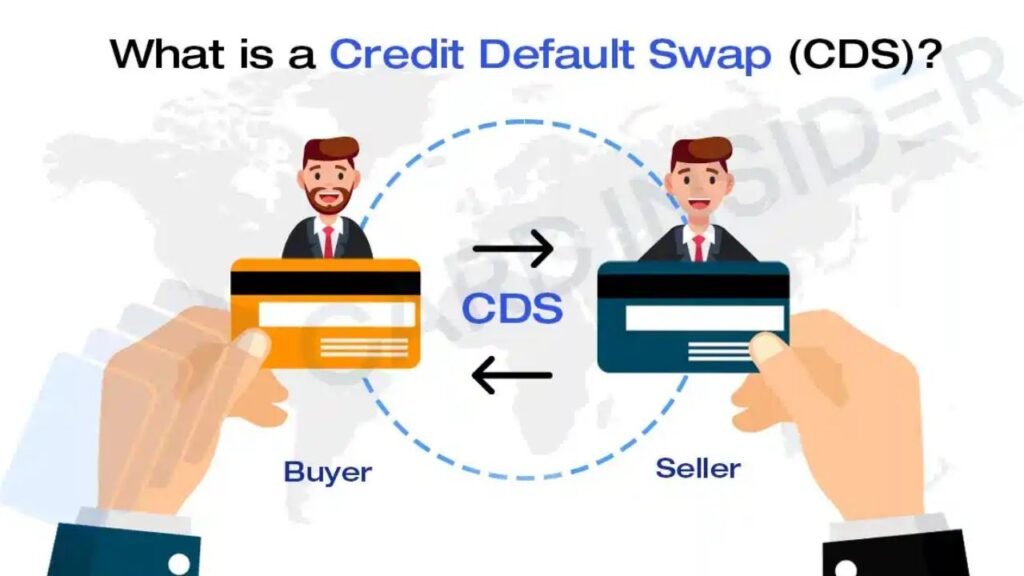
A credit default swap, often abbreviated to CDS, is a derivative contract that transfers credit risk from one party to another.
There are normally two main participants:
- Protection Buyer: Pays a recurring fee for protection from any particular credit event.
- Seller: Collects these payments and is committed to compensate the buyer if a credit event arises.
The contract is related to a reference entity, potentially a company, a bank, or a public authority. It could also reference a specific debt obligation like a corporate bond.
Consider the basic arrangement in this way.
Just imagine that the investment fund has 10 million United States dollar bonds that are issued by Company. The Fund could benefit from interest payments, but it is concerned that Company A might have financial problems.
Rather than sell its bonds immediately, the CDS fund could buy protection from another financial institution.
A fee is paid by the Fund every year. If Company A continues to pay its debt as usual, the protection seller would retain it. However, when a qualifying credit event occurs, the seller must compensate the Fund, if necessary, after the contract.
CDS contracts are often termed a default insurance for this reason.
The difference is, however, significant. A trader does not necessarily have to hold the Company A bonds to buy protection at Company A. It makes CDS not only useful for hedging, but also for speculation as to whether the financial situation of a borrower will improve or deteriorate.
How Credit Default Swaps Work Step by Step
Mechanics will be understood much more easily when the transaction is divided into individual parts.
1. A reference entity is chosen
The contract for CDS indicates a borrower that is being traded as a credit risk. This could be:
- A corporation
- A financial institution
- A sovereign government
- Another eligible debt issuer
The contract may also specify specific reference obligations, e.g., bonds or loans.
2. The buyer purchases protection
The secured buyer agrees to pay the protection seller for periodic payments.
On the contract notional value and CDS Spread, these payments are usually based.
Let’s say the investor buys $5 million CDS Protection, and the yearly spread is 200 basis points.
Because 100 basis points equals 1%, 200 basis points equals 2%.
Annual protection cost is therefore: $5 million × 2% = $100,000. The buyer pays the protection as long as the contract is active, assuming the agreed conditions are unchanged.
3. The seller accepts the credit risk
The seller receives the CDS payments as long as no qualifying credit event occurs.
The seller also assumes a much bigger obligation. In the event that the reference entity experiences a covered credit event, the protection seller can be required to compensate the buyer.
4. A credit event may trigger settlement
The stock price of a company that decreases by 30% will not automatically trigger a CDS.
The contract shall be subject to a specific credit event.
Common examples can include:
- Bankruptcy
- Failure to make required debt payments
- Certain forms of debt restructuring
- Repudiation or moratorium in applicable contracts
An exact trigger depends on the terms that regulate CDS.
5. The contract is settled
Settlement usually involves the payment of the value losses due to defaulted debt to a buyer performing the defence.
Two concepts are especially important:
Cash settlement
The seller pays an amount on the basis of the difference between face value and the debt’s recovery value.
Say, for example, a bond has a $ 1 million face value, but, as a default, it is worth only $400,000.
The estimated loss would be $1,000,000 − $400,000 = $600,000 under a cash settlement structure, which helps to establish the payment amount.
Physical settlement
The Buyer will provide the protection seller with the defaulted debt at its disposal and receive the contractual nominal amount in accordance with the contractual rules.
Modern CDS markets also use standardized auction practices to fix recoveries following certain credit events.
What CDS Spreads Tell Investors About Credit Risk
The dissemination of CDS is one of the most useful concepts for market understanding.
The spread is the price for the credit guarantee of the investment investor and is usually set in basis points.
As a simple rule:
- Less CDS Spread = lower perceived default risk
- Higher CDS Spread = higher perceived default risk
Suppose Company A has a five-year CDS Spread of 80 basis points and Company B trades at 450 basis points.
Most of the time, the market requires much more money to cover the debts of Company B. This suggests that traders consider Company B to be much riskier.
A spread can change even if the company didn’t really miss a payment.
Just imagine if disappointing earnings are released, debt will rise considerably, and investors are worried about cash flow issues. Traders may immediately require more funds for credit protection sales.
The CDS distribution might shift from 120 basis points to 250 basis points.
There’s no default yet, but the perception of risks in the market has changed.
This makes CDS pricing a good indicator of financial stress.
Why CDS spreads can move
Several factors may affect the price of protection, including:
- Declining corporate earnings
- Rising debt levels
- Credit-rating changes
- Recession expectations
- Industry-specific problems
- Political or sovereign risk
- Interest-rate conditions
- Market liquidity
- Expectations about recovery after default
A broader spread does not guarantee that a borrower will fail. Similarly, a close spread does not eliminate default risk.
It simply reflects the current willingness of the participants to pay for that risk transfer.
Parameta points out that spreads can react rapidly to changing credit conditions that help explain why professional investors are following CDS markets, along with bond prices and traditional credit ratings.
Why Investors and Financial Institutions Use CDS
It would be a mistake to think that the only reason these contracts exist is that traders are willing to gamble against a failed company.
Their uses are broader.
Hedging bond exposure
Consider the large corporate bond portfolio for a pension fund.
A manager may still consider bonds attractive, but be concerned about one issuer’s temporary risk.
The sale of the bonds may entail unwanted transaction costs or alter the portfolio structure.
A further option is to buy CDS protection.
If the company survives, then the company was financed for protection that it didn’t need. However, if a company defaults under certain circumstances, a hedge could reduce its associated losses.
Speculating on declining credit quality
Investors could also obtain protection without basic bonds, which are held at their disposal.
What if a hedge fund thinks the company with high indebtedness is much weaker than the market would understand?
Rather than the reduction of its bonds, the fund may acquire CDS protection.
If there is growing concern for the company and the CDS spread is growing, this protection can increase its market value.
One reason why CDS contracts differ from regular insurance is that they can be employed in a position without debt.
Taking credit exposure
It’s basically the opposite position the seller has taken.
By selling protection, an institution receives payments and allows a significant loss to be made later on.
In simple terms:
Buyer coverage: “I am willing to pay to reduce or profit from credit risk.”
Defence Representative: “I am willing to accept that credit risk in exchange for compensation.”
Arbitrage and relative value trading
Professional traders can also compare the prices of CDS to those of bonds.
For instance, if the company’s bonds appear to regard credit risk differently from CDS, difficult investors can have business transactions that would be beneficial if the price gap is finally closed.
Portfolio risk management
Big institutions seldom reflect on their attachment to isolation.
Banks, insurers, asset managers and pension funds may represent hundreds of credit risks. CDS contracts may enable managers to reduce the exposure of a particular enterprise, industry or group of borrowers, without restoring the whole portfolio.
Common varieties include:
- Name of CDS: Based on a single borrower only.
- CDS index: Based on the portfolio or box of reference units.
- Sovereign CDS: Linked to sovereign credit risk.
- Loan CDS: Designed to provide qualified loans.
The instruments give strong flexibility to institutional investors, but they also bring extra risk layers.
Benefits Risks, and the Role of CDS in the 2008 Financial Crisis
CDS can play a useful economic role by properly using it. In particular, they enable financial institutions to transfer credit risk to parties that are better prepared or capable of retaining it.
Potential benefits include:
- Credit Risk Management: Institutions may hedge risk without the sale of their bonds in full.
- Flexibility in the portfolio: Managers can focus on single borrower groups or wider credit markets.
- Price discovery: CDS spreads send a different market-based signal of the borrower’s perceived risk.
- Trade flexibility: Investors can obtain or lower credit exposure without buying or selling physical bonds.
- Liquidity: The markets for Active derivatives may assist institutions to adjust specific exposures.
But CDS contracts do not have the potential to destroy risk.
They move it somewhere else.
And that distinction matters.
Counterparty risk
Maybe the easiest risk is to miss out on the financial strength of the protection seller.
What if the bank is buying CDS protection because it’s worried that Company A might fail?
Company A defaults.
In most cases, the protection seller has to ensure that the bank is compensated. What happens, however, when the protection seller encounters severe financial difficulties?
The hedge can fail just when it’s most necessary.
It’s called counterparty risk.
Leverage and interconnected exposure
These derivatives may lead to significant economic exposure to the initially traded volume of cash between participants.
While the contracts link many banks, dealers, insurers and investment funds, problems at a large institution may quickly cause concern for the other.
Complexity
One CDS may appear easy from the beginning; one party pays compensation, while the other affords protection – but professional contracts might include difficult issues in relation to:
- Eligible reference obligations
- Contract maturity
- Recovery values
- Restructuring rules
- Settlement methods
- Collateral
- Counterparty exposure
This complexity implies that CDS contracts are mainly institutional financial instruments instead of products which are intended for normal retail investors.
What happened during the 2008 crisis
Credit derivatives have become closely linked to the global financial crisis, as there are huge amounts of securities in US mortgage-backed securities.
When mortgage losses rose, many of their securities were in a sharp decline in value.
This generated a serious difficulty: some of the institutions that sold protection experienced massive potential obligations at precisely the same time as the financial markets were under considerable pressure.
AIG has been a prominent example. The exposure risk of the CDS was one of the concerns that the failure of a large networked institution might result in any loss being transferred throughout the financial system.
This crisis has highlighted a key point: risks are not transferred if the institution which receives them is not able to endure losses.
The CDS market has been subject to more regulation, reporting, clearing practices, security requirements, and contractual standardisation in the crisis’s aftermath. In the United States, derivatives reforms within the Dodd-Frank framework have significantly altered market oversight. Key elements of CDS trading and resolution were also standardized by industry protocols.
This history is also the reason why it’s misleading to say CDS products themselves “caused” the crisis. Mortgage losses, excessive leverage, weak takeover, securitization practices, interconnected institutions, and insufficient risk management contributed. The CDS contracts helped transfer and reinforce some of these risks as a result of major interlinked exposures which were created by institutions.
Frequently Asked Questions
What is a credit default swap in simple terms?
It is a financial contract in which one party pays the other party for taking risks resulting from the credit period that a borrower is going through.
Are credit default swaps the same as insurance?
Not exactly. They remind you of insurance, as they might protect you from losses. But investors could buy CDS, even if they have no primary debt. Usually, for normal insurance, insurable interest is required.
What does a rising CDS spread mean?
An increase in spread means that the market generally considers the borrower to be riskier. Investors require more payments to protect themselves from potential default.
Can individual investors buy CDS contracts?
The CDS market is used mainly by banks, hedge funds, insurers, asset managers, and other highly developed institutional stakeholders. In general, this is not a retail investor product commonly used in the market.
What happens when a company defaults?
In accordance with the settlement, the Seller that provides protection shall compensate the Buyer for any event underthet CDS contract. Payments usually include a difference between the debt’s nominal value and the post-default replacement value.
Conclusion
Credit default swaps can be intimidating for their depth in institutional credit markets, but the key idea is simple: one party pays another to take on credit risks. The benefits are the provision of flexible hedging, trading, and risk measurement techniques for investors. Its danger occurs when it is difficult to control leverage, complexity, or counterparty exposure. For everyday investors, understanding CDS does not mean that you have to trade them; instead, they provide a different window into how Wall Street evaluates the financial health of companies, governments, and the wider credit market.
For more information, also read our related article here.