
Investing isn’t always a pension-driven thing. You may be raising money for a future home, hoping to retire before your 60s, or simply looking for a place to invest after choosing your regular retirement contributions. More flexibility can be valuable in such situations.
A taxable brokerage account allows investors to access shares, bonds, ETFs, investment funds, and other investments without many retirement account-related contributions and withdrawal restrictions. The compromise is simple: The account does not offer the same tax protection as a Roth IRA or 401 (k).
That doesn’t make it a bad choice automatically. The brokerage account for many investors works in conjunction with retirement accounts, instead of replacing them. Understand when taxes are taken, what investments can fit in the account, and how withdrawal rules can help you decide if it deserves a place in your financial plan.
What Is a Taxable Brokerage Account and How Does It Work
A taxable brokerage account is a regular investment account opened via a brokerage company. You deposit money, select investments, and generally purchase or sell when the market is available.
The word “taxable” is important, as the investment income coming from the account could create a tax liability. Other than a traditional 401(k), IRA, or similar tax-advantaged account, investments within the account did not cause their taxes to be postponed automatically.
A typical account can give you access to investments such as:
- Individual stocks
- Exchange-traded funds or ETFs
- Mutual funds
- Corporate and government bonds
- Certificates of deposit
- Money market funds
Options, if your broker approves the account for them. Brokerage companies can offer individual, collective, trust, and other ownership schemes.
Flexibility is one of the key features. There is usually no federal annual contributions limit, and investors will not be required to wait until a certain age before they access their money for a standard brokerage account. Fidelity emphasizes this flexibility as one of the large differences between ordinary brokerage and pension accounts.
Assume you’ll be investing 10,000 dollars and depositing it into some ETFs. If these investments rise to 13,000, then the additional $3,000 will be the unrealised gain while you are holding them.
The sale of investments can turn this growth into the realization of capital gain, which may have tax implications.
One of the most important concepts for new investors is to understand this distinction between unrealised and realized profits.
How Taxes Work in a Brokerage Account
The name may sound as though every dollar inside the account is constantly being taxed. That is not quite how it works.
Different types of investment income receive different tax treatment.
Capital gains
If you sell your investment for more than your cost basis, then usually you have a capital gain.
Your cost basis is usually the result of your paying for your investments when applicable.
For example:
- You purchase shares for $4,000.
- You’re going to sell them at $5,500 later.
- And your capital gain would be about 1,500 before you think of the adjustments you make.
- Your investment time is likely to change the situation significantly.
Short-term capital gains are usually derived from holdings in an investment for one year or less. At ordinary income tax rates of the Federal Government, the net profit from short-term gains is generally taxed.
Long-term capital gains usually apply if investments are held for a holding period of over one year. Federal long-term capital gains can, depending on taxable income and other circumstances, receive preferential rates, typically 0%, 15%, or 20%.
This brings a potential tax advantage to investors in long-term compared to frequent purchases and sales of profitable investments.
Dividends
Having dividends-paying shares or funds may also generate taxable income.
Eligible dividends can benefit from preferential long-term capital Gains taxation rates when applicable requirements are met. Other dividends may be taxed as normal profits.
What is important is that automatic reinvestment of the dividend is not necessarily tax-free. You can still earn taxable returns from the dividends, even if cash buys more assets immediately.
Interest
Interest on investments, including taxable bonds, CDs, or some financial assets, is generally treated as taxable income.
Some investments have special treatment. Although the tax may differ from the State and from other rules, for example, the interest rate for eligible municipal bonds may be generally exempt from federal income tax.
Capital losses
Losses are unpleasant from an investment perspective, but they can sometimes provide tax benefits.
Capital losses can generally offset capital gains. If total allowable losses exceed gains, individuals may generally deduct up to $3,000 of net capital losses against other income each year, or $1,500 for someone married filing separately. Unused qualifying losses can generally carry forward to future years.
Imagine you have:
- $5,000 in realized capital gains
- $2,000 in realized capital losses
The losses can generally reduce the net gain to $3,000 before the applicable tax calculation.
That ability to deliberately realize losses to offset gains is commonly called tax-loss harvesting.
Investors need to be careful with the wash-sale rule, however. Selling securities for a loss and acquiring substantially identical securities within the applicable 30-day period before or after the sale can prevent the loss from being immediately deductible.
Taxable Brokerage Account vs Roth IRA and 401k
One mistake beginners sometimes make is assuming they need to choose either a brokerage account or a retirement account.
In reality, each account can serve a different purpose.
| Feature | Taxable Brokerage Account | Roth IRA | Traditional 401(k) |
| Annual contribution limit | Generally none | Yes | Yes |
| Income restrictions | Generally none | Can apply | Generally no income eligibility limit for employee contributions |
| Access before retirement | Generally flexible | Rules apply | Restrictions may apply |
| Upfront tax deduction | No | No | Contributions may generally be pre-tax in a traditional plan |
| Tax on investment activity | Potentially taxable | Generally sheltered while inside account | Tax-deferred while inside account |
| Qualified retirement withdrawals | Not applicable | Generally tax-free | Generally taxable |
| Investment selection | Often broad | Often broad | Depends on employer plan |
| Required retirement purpose | No | Primarily yes | Primarily yes |
The losses are, from the point of view of investment, unpleasant, but sometimes they can give tax benefits.
In general, Capital losses can offset the asset gains. If allowable losses exceed the total, individuals can usually deduct up to $3,000 of the net capital losses against other gains each year, or $1,500 for each married person filing separately. Any unused qualifying losses can generally go on over the next years.
Imagine that you have: $5,000 in realized capital wins $2,000 in realized capital loss The losses can usually decrease the net profit up to $3,000 prior to applicable tax calculation.
That ability to purposely realize losses to offset profit is often referred to as tax-loss harvesting.
However, investors must be cautious about the wash-sale rule. The sale of securities for losses and the acquisition of essentially identical securities within the current 30-day time limit before or after the sale may prevent the loss from being immediately deductible.
Benefits and Drawbacks You Should Consider
No investment account is automatically right for everybody. A better way to evaluate one is to understand what you gain in exchange for what you give up.
Benefits
No standard federal contribution ceiling
Unlike IRAs and employer retirement plans, there is generally no IRS-set annual limit on how much after-tax money you can add to a regular brokerage account.
That can be useful for investors who have significant savings to deploy.
Access to your money
You generally do not have to reach a particular age before withdrawing money.
Keep in mind that selling investments to create the cash may generate capital gains or losses.
Broad investment selection
Many brokers provide access to thousands of stocks, ETFs, bonds, mutual funds, and other securities.
Investors can therefore build portfolios ranging from a simple broad-market ETF strategy to more specialized allocations.
Useful for multiple financial goals
The account does not have to be labeled “retirement,” “education,” or another specific purpose.
You might invest toward:
- Early retirement
- A future home purchase
- Long-term wealth building
- Financial independence
- A future business
- An inheritance goal
- General investing beyond retirement accounts
Potential estate-planning advantages
Certain inherited assets may receive a stepped-up tax basis under current federal rules, potentially reducing embedded capital gains for heirs. Fidelity identifies estate planning as another notable distinction between taxable brokerage accounts and 401(k)s.
Drawbacks
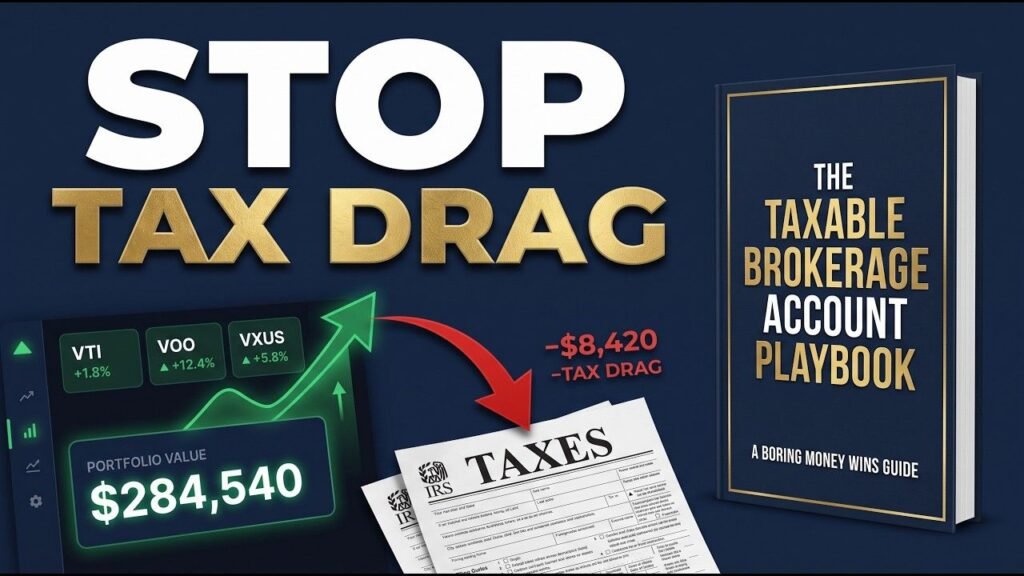
Annual tax drag
Dividends, interest, fund distributions, and realized gains can create taxable income along the way.
Over many years, those taxes can reduce the amount remaining invested and compounding.
No contribution deduction
Putting $5,000 into the account normally does not reduce your taxable income merely because you invested the money.
More tax recordkeeping
Investors need to pay attention to cost basis, sales, dividends, losses, and brokerage tax documents.
Brokers generally report basis information for many covered securities on Form 1099-B, but investors remain responsible for keeping accurate records, particularly when information is missing or involves older/noncovered holdings.
Investment risk remains
The word “brokerage” does not mean your investment value is guaranteed.
Stocks, ETFs, bonds, and other investments can decline.
A taxable brokerage account is simply the container. Your investment choices determine much of the risk inside it.
When Does a Taxable Brokerage Account Make Sense
There is no universal point at which every investor should open one. Your goals matter more than the account itself.
Here are some situations where it may be particularly useful.
You already have a solid retirement strategy.
Someone taking full advantage of an employer match, funding an IRA, or otherwise making strong use of tax-advantaged accounts may want another place to invest additional savings.
A taxable brokerage account can fill that role without imposing another annual contribution ceiling.
You are investing for a goal before traditional retirement age
Suppose your goal is financial independence at 48.
Money locked primarily into retirement vehicles may not offer the same straightforward flexibility as money held in a regular brokerage account.
The ability to sell investments and access cash without an account-level early-withdrawal penalty can be valuable.
Taxes on realized gains may still apply.
You want flexibility without a specific spending category
Accounts such as 529 plans and HSAs can offer valuable tax benefits, but they are designed around particular purposes.
A standard brokerage account is much less restrictive.
Today the money may be part of your early-retirement plan. Ten years from now, you might decide to use some of it for a home.
You want to invest rather than leave all long-term money in cash
Cash is appropriate for emergency funds and short-term expenses because investments can fall at inconvenient times.
But money intended for goals many years away may have a different job.
Investors willing to accept market risk may use brokerage accounts to seek long-term growth.
That does not mean investing money you will need next month. The shorter your timeline, the more damaging a market decline immediately before you need the money could be.
A useful way to think about the account is:
Retirement accounts are often built around tax advantages. A brokerage account is built around flexibility.
A strong financial plan may use both.
How to Open and Manage a Brokerage Account Wisely
It usually is easy to open an account, but taking the first advertising type of brokers you see is not necessarily a better approach.
Start by comparing providers.
Look at factors such as:
- Account fees
- Trading commissions
- ETF and mutual fund availability
- Fractional-share support
- Cash-management options
- Research tools
- Automatic investing
- Customer service
- Mobile and desktop experience
- Account security
- Transfer fees
Availability of joint or specialized accounts
When you open up the account, decide what it really is you should do with money.
Investing without purpose tends to promote random decisions.
Instead, answer three basic questions:
When would I need that money?
A person who invests for 20 years can generally face greater volatility in the short term than someone who plans on using money for three years.
How much risk can I be able to cope with in a realistic way?
A large-looking portfolio in the rising markets might feel quite different following a reduction of 30%.
Your allocation should be a sensible one to last for the difficult times.
How complicated must my portfolio be?
It is not automatically better for many long-term investors to have complicated investments.
A diversified portfolio of low-cost funds can expose hundreds or thousands of businesses without constantly having to buy or sell stock.
The portfolio’s administration should also be affected by taxes.
Strategies that may help include:
Keep investments longer when, in accordance with your investment strategy; avoiding unnecessary trading Using tax-efficient ETFs or funds, where appropriate; placing fiscally inefficient investments in tax-advantaged accounts, if suitable; using capital losses strategically; monitoring capital gains from investment funds; keepingg good cost-basis data
This broader strategy is sometimes “the location of assets”: the choice of not only what type of investment you have, but the kind of accounts you hold.
For example, an investor might prefer to keep a relatively tax-efficient stock index ETFs in a taxable account while holding investments generating significant normal income within a retirement pension account.
The right arrangement depends on your complete tax situation, your portfolio and your targets.
You must have a qualified tax expert or financial adviser to answer your individual circumstances before taking major tax-controlled steps.
Frequently Asked Questions
Do I pay taxes just for putting money into a brokerage account?
Generally, no. Usually you finance an account using already-taxed money. Taxes usually come from investment earnings such as interest or dividends, or when you get a taxable income.
Can I withdraw money whenever I want?
Generally, yes. Standard tax accounts do not impose restrictions on pensionable age regarding many pension accounts. But you might have to sell your investments first, and profit-making sales could result in taxed capital increases.
Is a brokerage account better than a Roth IRA?
Neither is automatically better. A Roth IRA has valuable tax benefits, but comes with eligibility, contribution, and withdrawal rules. An account, which is taxable, has more contribution and redemption flexibility, but less tax advantages.
How much money do I need to open one?
It depends on the brokerage. Many major US brokers now offer very low or no opening minimums accounts. Fractional stocks can give investors the opportunity to start with relatively small amounts. Fidelity, for example, does not report a minimum funding requirement for your Standard Brokerage account.
Can I lose money in a taxable brokerage account?
Yes. The account does not prevent market losses in itself. If the shares, funds, bonds, or other investments that you are purchasing lose value, your balance can also decline.
Conclusion
One of the most flexible instruments available to an investor can be a taxable brokerage account. It does not provide the same tax shelter as a 401(k), Roth IRA, or another special account, but it compensates for a wide range of investment choices, lack of a standard federal contribution limit, and ease of access to your money.
If a brokerage account is better than a retirement account, the smartest question for many people is not. And they can work together, that way. Pension accounts can contribute to maximizing valuable tax benefits, while taxable investments can ensure access to early retirement assets, long-term objectives, and value added for wealth.
Investing for a specific purpose is a key element. You see, when taxes go off, keep unnecessary trading under control, select the investments that are in accordance with your timeline, and look at the account as part of your general financial plan, not as a short-term track for rapid return.
For more information, also read our related article here.