
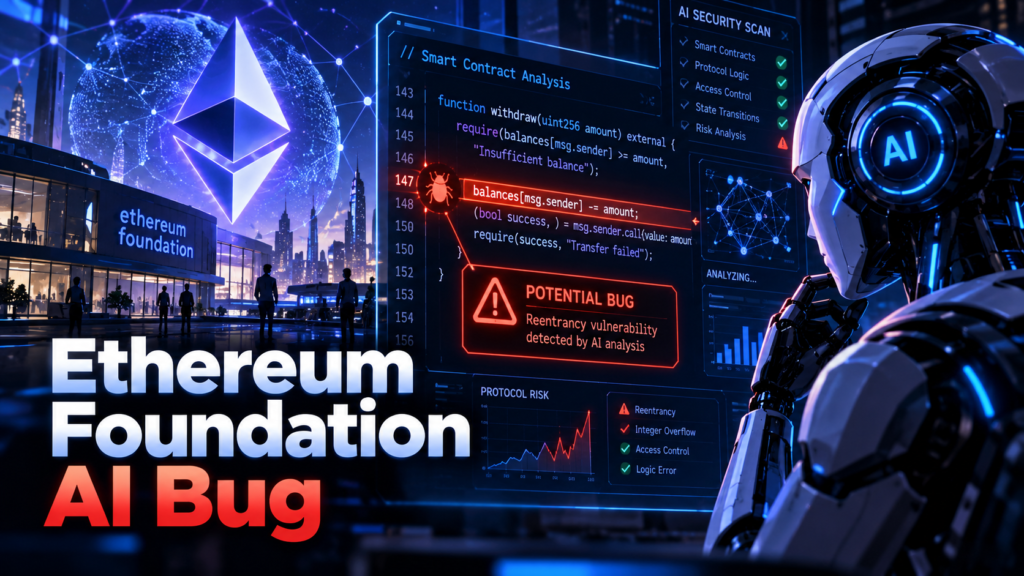
Artificial intelligence is becoming much more than a tool to write code or automate routine developer tasks. It is increasingly used to inspect complex software, test assumptions, and search for vulnerabilities that might otherwise be concealed. For blockchain networks, in which a small software error could affect thousands of nodes and billions of dollars of assets, this ability has serious implications.
To date, a new Ethereum Foundation AI bug discovery has provided one of the clearest examples. The Ethereum Foundation Protocol Security team has experimented with coordinated AI agents that investigate critical software which was used around Ethereum. These agents have successfully identified real vulnerabilities, including a remotely triggerable problem in the libp2p gossipsub component, which was later identified and announced as CVE-2026-34219.
And more importantly, in that story, it’s not like artificial intelligence found a bug. Ethereum experiment revealed an important factor about the future of cybersecurity: AI can dramatically expand the number of vulnerabilities that researchers investigate, but it may also cause compelling errors. This means that human know-how, reproducible testing, and careful validation may be even more important as AI improves security tools.
What Did the Ethereum Foundation AI Bug Actually Involve?
The Ethereum Foundation Protocol Security group has been conducting tests of coordinated AI agents against software that depends on Ethereum and surrounding infrastructure. The goals are system software, cryptographic code, and security-sensitive contracts. Instead of asking an AI model to see a full codebase, researchers are organizing several agents around various security tasks.
One confirmed finding involved libp2p gossipsub, technology that was used within the peer-to-peer networking layer on which Ethereum consensus clients operate.
The vulnerability was ultimately exposed as CVE-2026-34219.
This problem was causing a remotely triggerable panic at the technical level. A malicious peer may send specially designed data with an unusually large backoff value. Processing this value can ultimately lead to overflow and a crash of the software.
This is important because peer-to-peer communications are fundamental to blockchain infrastructure. Ethereum nodes must be able to communicate reliably with other nodes in order to share information and keep the network operational.
The important details are:
- The vulnerability may be activated remotely.
- The gossipsub component from Rust libp2p was involved.
- An attacker did not need regular authenticated access to take advantage of the security path.
- AI agents were helping to identify the error.
- Before looking at the subject as a real vulnerability, researchers had acknowledged its validity.
- The issue has been solved and made public.
Therefore, the discovery should not be construed as proof that Ethereum has been suddenly affected by AI. It shows almost the opposite: Defenders start with AI to identify weaknesses before attackers use them.
This distinguishes things, especially when headlines about AI and cryptocurrency security are getting more dramatic.
How Ethereum Foundation Uses AI Agents to Find Bugs
The process could be the most interesting part of that experiment.
Traditional software security testing usually combines techniques like code review, fuzzing, penetration tests, formal checks, and bug bounty programs. Ethereum itself maintains a bug bounty program that includes areas such as consensus, connectivity, execution clients, and protocol specifications.
AI adds a further layer to the security model.
The Ethereum Foundation didn’t just tell a chatbot to “find vulnerabilities.” The approach uses coordinated agents who execute specialist jobs. Four broad roles are described in the project’s report.
Reconnaissance
So the first task is to focus a massive codebase on specific security questions.
Rather than looking suspiciously for suspicious things, an agent may explore boundaries of trust, inputs, and assumptions prior to the creation of testable hypotheses.
For example, it could ask whether information that is controlled by attackers can reach a particular function without adequate validation.
Hunting
The other agent could examine this hypothesis.
It monitors the appropriate code paths and attempts to determine if a suspect weakness could be actually activated. If possible, it also creates a reproducer or a proof of concept.
And that’s a big difference between finding a suspicious code and showing a genuine vulnerability.
Gap Filling
Agents may also keep track of the areas already examined.
If one hypothesis is rejected, duplicated, or confirmed, the other agent could explore unexplored attack surfaces instead of having it examined frequently.
This enhances the effectiveness of the parallel security research.
Validation
The most important stage comes last.
Potential vulnerabilities must survive after independent verification. Researchers need evidence demonstrating that a problem is actually at an attacker’s service in realistic conditions.
Here, the Ethereum experiment exposed its biggest lesson.
Why Human Validation Matters More Than Ever
At an outstanding rate, AI may produce security conclusions.
Unfortunately, it’s not the same thing to create a convincing vulnerability report and discover a genuine vulnerability.
The Ethereum Foundation considered a significant part of the workload to be separating legitimate discoveries from false positives. The Protocol Security team emphasised Triage as the biggest challenge rather than merely finding suspicious behavior.
AI agents can create reports that may seem technically sophisticated and include basic issues.
Some common examples include:
- Debug-only crashes: An AI system may detect a crash occurring in a development environment but not able to occur in the actual implementation of the software configuration.
- Unreachable code: There may be a theoretically vulnerable function, but attacker-controlled inputs could never make it.
- Duplicate Discoveries: Agents can rediscover weaknesses and behaviors that developers have repeatedly known.
- Weak proof: A formal test can be technically successful but without actually demonstrating the security property to researchers.
- Out-of-scope findings: Something can be abnormally real without a meaningful security breach.
This changes how we think of the cybersecurity of AI.
The value of the future AI security system may not be the system which produces the greatest number of vulnerability reports. That can be the system which creates the highest percentage of reproducible and relevant findings.
The Ethereum approach pays a lot of attention to reproducibility. A candidate vulnerability should demonstrate that other researchers may independently test the real software.
This requirement prevents a confusion of confidence with accuracy.
AI can propose.
Testing can reproduce.
People eventually decide if the evidence represents a real security problem.
What the Discovery Means for Ethereum Security
Since Ethereum is an exceptionally complex technology ecosystem, the Ethereum Foundation AI Bug Story is important.
Security is not confined to a smart contract.
Ethereum depends on many interconnected layers, including:
- Execution clients
- Consensus clients
- Peer-to-peer networking
- Cryptographic libraries
- Validator software
- Protocol specifications
- Smart contracts
- Supporting developer infrastructure
Ethereum’s official bug bounty program includes, e.g., execution clients including Besu, Erigon, Geth, Nethermind, and Reth, and several consensus clients. The program deals in particular with issues of network security, denial-of-service vectors, implementation errors,, and inconsistencies.
AI agents could help researchers to continuously investigate those major fields of attack.
The Human Security Researcher has limited time available. Even an experienced audit team cannot check every possible interaction manually across millions of code lines when switching software.
AI agents can operate differently.
They can treat numerous hypotheses in parallel, analyse unusual assumptions, and track complex inter-functional linkages much sooner than just manual reviews.
This does not eliminate usual security practices. Instead, AI may become another part of a layered defense strategy.
A strong future security process might combine AI-assisted review with:
AI agents → automated testing → fuzzing → reproducible proof → expert review → responsible disclosure → patching. The value comes from combining those techniques rather than treating AI as an autonomous replacement for security researchers.
AI Could Strengthen Crypto Security and Create New Threats
There is another aspect of such a development.
Attackers could also be equipped with the same capabilities that allow defense personnel to scan software faster in the end.
Since AI agents are exceptionally good at understanding large codebases, malicious researchers may potentially use similar systems to search for open-source cryptocurrency infrastructure for exploitable vulnerabilities.
The Ethereum community is increasingly taking this opportunity into account.
Ethereum researcher Justin Drakerecently argueds that cryptocurrency systems should prepare for scenarios where AI quickly enhances opportunities to challenge existing security assumptions. His comments have sparked debates on how aggressively the crypto sector should prepare in terms of potential AI-powered attacks.
Worries go beyond common software bugs.
Future AI systems could potentially improve attackers’ ability to:
Analyze enormous open-source repositories.
Search continuously for overlooked vulnerabilities.
Generate and test exploit ideas.
Automate the components of complex phishing campaigns.
Identify wallet and infrastructure weaknesses.
Accelerate research into cryptographic attacks.
None of that means AI can currently break Ethereum’s underlying cryptography or steal ETH out of secure portfolios suddenly.
There’s a big difference between finding software implementation errors and breaking cryptographic foundations that protect digital assets.
The vulnerability in libp2p belongs to the first category.
However, the design speed of AI gives a strong basis for blockchain developers to prepare at an early stage rather than waiting for the AI offensives to rise considerably.
It creates something similar to a cybersecurity race.
Attackers gain better automation.
Defenders gain better automation.
The winner can be whoever’s machines can most effectively combine with trained human researchers.
What Comes Next for AI-Powered Blockchain Security
After this experiment, it is unlikely that AI-backed vulnerability discovery will disappear.
Its role will probably expand.
Experience with Ethereum indicates that AI agents are already able to produce useful security research by placing it in a disciplined testing and validation process.
There are some lessons that are distinct for blockchain developers.
Think of AI as a researcher, not as an authority, and the findings generated by AI shall be considered hypotheses until independently reproduced.
- Prioritize reproducible evidence. The detailed explanation is useful, but executable evidence’s much stronger.
- Keep people in the validation process. Experienced security researchers understand context, exploitability, and real-world effects, which automated systems may misjudge.
- Use multiple security layers. AI should supplement traditional audits, fuzzing, formal checking and bug bounty programs instead of replacing them.
- Get ready for a similar tech attacker. Open-source blockchain development means defenders cannot presume that comprehensive code analysis capabilities will continue solely for legitimate researchers.
This also has a wider lesson.
AI security tools can change what makes a major cybersecurity researcher.
Much of the work has been done in search of suspicious conduct manually in the past. A growing number of researchers can spend more time designing experiments, defining security properties, evaluating machine-generated hypotheses, and proving whether vulnerabilities can be effectively exploited.
While the judgment becomes even more valuable, in other words, AI can automate some search.
FAQs
Did AI really find an Ethereum vulnerability?
Yes. The Ethereum Foundation confirmed that coordinated AI agents have helped to detect real vulnerabilities, including a remote-triggerable panic in the gossipsub component of libp2p, revealed as CVE-2026-34219.
Was the Ethereum network hacked because of this bug?
There is no indication in the Foundation Revelation that this discovery constitutes a successful hack of Ethereum. The vulnerabilities reported had been identified, confirmed, disclosed, and made public.
Can AI replace blockchain security researchers?
Not currently. AI can quickly generate hypotheses and inspect code. But the Ethereum Foundation’s work demonstrates that human validation remains important to remove real vulnerabilities from false positives.
Why is the Ethereum Foundation using AI for security?
AI agents may work in parallel on large-scale code and a variety of possible avenues for attack. This can help researchers to more effectively identify weaknesses together with established security practices.
Could hackers also use AI to find crypto vulnerabilities?
Yes. The same code analysis capabilities that help defensive researchers may help attackers search for weaknesses. That’s one reason blockchain projects are exploring AI-supported defensive security before offensive capabilities are being refined even more.
Conclusion
The Ethereum Foundation AI Bug Discovery is more than just an intriguing artificial intelligence experiment. It provides an early view on how blockchain cybersecurity can operate in a time when machines can inspect code, generate attacking assumptions, and test vulnerabilities at a scale people may not easily match.
The encouraging thing is that AI has already proven practical value, revealing a genuine and distant triggerable vulnerability. The warning is that AI also produces large volumes of convincing noise, making careful triage and expert verification essential. Experience with Ethereum indicates that the strongest security model will not be AI versus humans.
It will be AI which will work together with experienced scientists, reproducible testing, traditional security tools, and responsible disclosure. The combination could be one of the most important defense elements protecting the blockchain infrastructure as AI capabilities continue to improve.
For more information, also read our related article here.